

Have I now found the only corporate booth at the entire congress?
The question came from a visitor as she drifted over to our table—curious, not accusatory. It’s a reasonable question to ask in the context of a collectivist hackerspace carnival like the Chaos Communication Congress. And the short answer was: no. This wasn’t the first time the event had hosted commercial actors. It was just the first time we were there.
The longer answer explains why the question still made sense. Yes, there were businesses, like Blinkyparts, for example: Well stocked, and busy all day. But just a few steps away, the no-cost Hardware Exchange told the rest of the story. Boxes of components, half-finished projects, adapters, cables, tools—brought by strangers, utilized by others. That contrast explains a lot about this place. Tools are treated as shared infrastructure. Knowledge and curiosity are the real currencies.
Assemblies, Infrastructure, and Reliability
The Chaos Communication Congress isn’t organized around exhibitors and aisles, but around assemblies: self-organized spaces run by communities who decide what belongs, what’s useful, and what they want to spend four days doing together. We ended up in the Hardware Hacking Area, which was all about “physical things”. Workshops led by people like Mitch Altman ran alongside spontaneous troubleshooting sessions. Someone might be finished soldering their board, turn around, and help the next person bridge a stubborn joint.

In a room where learning happens with hot irons and shaky hands, reliability isn’t a nice-to-have. It’s the difference between curiosity turning into skill—or stalling out entirely. Over the course of the Congress, ninety-six of our soldering irons ran from morning til well past midnight. They moved between workshops, competitions, first-timers, and people who clearly knew what they were doing. One of these arenas was the handsoldering competition run by the SegFaultDragons—a focused test of skill. The first prize? One of those very same soldering irons!
This was quite the stress test for both the competitors and the irons themselves. Luckily, the results were quite admirable.
One thing we didn’t expect was the volume of people who wanted to give something back. The iFixit platform and our Right to Repair lobbying are financed by selling tools and parts, but people clearly wanted to donate. The instinct came from the same place as the Hardware Exchange table nearby: if something enables learning, it’s worth sustaining collectively. That’s already part of the Congress’s social fabric. And for anyone who asked how to support repair education beyond a purchase, there is a path: donate to the iFixit Foundation. It is the driving force behind our Education Program, which has partnered with 102 universities around the world to teach repair and technical writing. Of course, if you’re at an event like the Congress, you’re already doing your part. Putting in the time to teach others to repair, whether by answering questions in online forums or picking up a soldering iron, is a great way to sow the seeds of a repairable future.
Skill as Play
That approach to learning showed up in deliberately playful ways, too. Kliment ran a workshop centered around a small, cat-shaped PCB. Solder it well and it would purr when you touched it. Get it wrong and it hissed back. People laughed, tried again, adjusted their technique. They were learning how sensitive components behave—and how much precision matters—through immediate, tactile feedback.

Kliment’s talk “Building hardware – easier than ever – harder than it should be” laid out exactly that tension: access to tools and knowledge has never been better, yet social and cultural hurdles still keep many people from getting started. It’s a perspective that resonated far beyond the room. Hackaday picked up the talk as a narrative entry point into the Congress, because it touches the core of repair culture: if you lower the barrier to entry without lowering standards, people don’t just learn faster. They stick around.
That sense of capability wasn’t limited to hardware. In talks like “The Heartbreak Machine: Nazis in the Echo Chamber”, the same confidence showed up in a very different context—using technical skill, research, and persistence to expose and disrupt harmful systems. The details mattered, but the underlying belief was familiar: complex problems aren’t untouchable. With enough care, transparency, and collective effort, even entrenched structures can be understood and changed.
That seriousness didn’t crowd out playfulness—it lived right next to it. Just a short walk from talks about infrastructure, abuse, and power, there was a ball pit. An actual one. Officially part of the Congress program, used without irony. People napped there. Talked shop there. Reset their brains between sessions. It wasn’t a contradiction. It was a pressure valve. A reminder that curiosity works best when people feel safe enough to be a little ridiculous.
Agency, Everywhere
What tied all of these moments together was a shared sense of agency. At the Chaos Communication Congress, people don’t just consume technology—they interrogate it, rebuild it, and adapt it to their needs. The same mindset that drives deep technical talks about infrastructure, security, or ethics shows up just as clearly at a soldering table. If a system matters, you should be able to understand it. That’s where repair culture fits in. A tool understood is a dependency reduced. Watching people move so fluidly between learning, fixing, and teaching made that connection impossible to ignore. Across the Congress, the same question surfaced again and again—sometimes in talks about power and abuse, sometimes at worktables and soldering stations. Who controls the systems we depend on? And what does it take to push back when they fail or are misused? Different scale. Same instinct.
Nothing Felt Unachievable
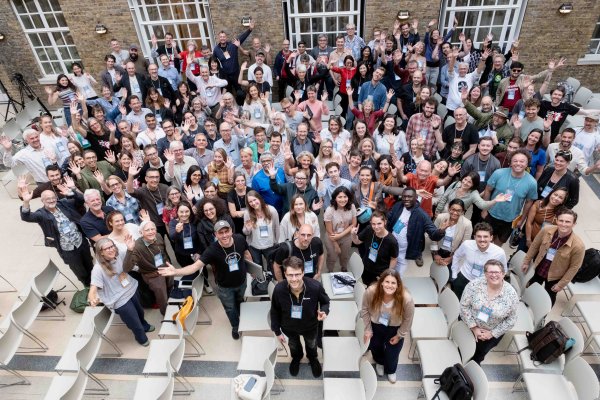
What stayed with us most was the confidence in the room. Nothing felt out of reach—not because things were easy, but because difficulty wasn’t treated as a signal to stop. With the right tools, shared knowledge, and a community that treats learning as collective work, even complex systems felt approachable. That’s the mindset repair depends on—and the reason iFixit belonged there in the first place.
Together, we can fix any thing.


2 Yorum
It's disingenuous to say this article was written by a person when it's clear as day it was written largely by AI. Not even AI assisted. Much of the prose is clearly pulled straight from an LLM.
Shaddycat - Yanıt Paylaş
I'm sorry you feel that way, @shaddycat. It's true I had a bit of help, both from machines and humans, I felt I needed that given that I'm not a native speaker. The description of what I experienced and felt, however, is real and personal. That's what I find so great about community events: Everyone is at the same spot, at the same time, but all of us will highlight and remember different things.
Sandra Hiller - Yanıt Paylaş