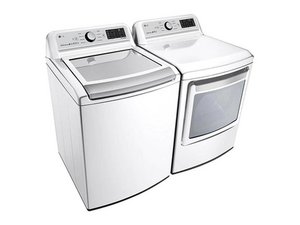
My top load LG washer with a medium sized load made groaning noises when the wash cycle was starting and then threw an LE error code. After emptying I ran a diagnostic cycle and it went through all functions fine. What are the most likely culprits and/or what is the troubleshooting flowchart.
You gave the most useful clue yourself: it passes empty and fails loaded. Hold onto that, it splits the flowchart in half.
What LE actually means. LG's own help page says the tub failed to spin and the motor can't operate properly, either because the load is too much for it or because something is stuck in the tub. It is not a water-level code and it is not a drain code. It is the drive saying "I'm being asked to move something I can't move."
Why the empty test passed. An empty drum is almost no torque. The diagnostic proves the control board, the motor windings and the sensor can run a free rotation. It says nothing about the machine under load. So a pass there does not clear the motor side, it just moves the suspicion to whatever only shows up with weight and water in the tub.
Order of checks, cheapest first, and stop at the first one that changes the behavior.
1. Load and cycle. Heavy, tight loads (towels, jeans, blankets) on a normal cycle are the number one cause. Two or three items, same cycle. If it runs clean, the drum isn't broken, the load was too much for the water level the machine picked. Bulky or bedding cycle for the heavy loads. Cheapest test you'll ever run.
2. Something between the inner and outer tub. A bra wire, coin, or small hard object drags and makes exactly the groan you describe, and the motor reads the drag as a locked rotor. Unplug, pull the tub and look and listen. Note this is not the pump filter, that one throws a different code.
3. Level and clearance. A top-loader that isn't level, or is on a floor that flexes, walks the outer tub into the cabinet under a load. Check all four feet, then push the tub by hand side to side and look for contact with the cabinet. A groan with visible rubbing here means suspension or level, not motor.
4. With the machine unplugged, turn the tub by hand. It should move smoothly with some resistance and no wobble. Grinding means bearing. Wobble or a knock means suspension or the tub support spider. Either one is a mechanical job, not a sensor job.
5. Only then, the motor side. Unplug it, take the back or the rotor cover off, and check three things: the center rotor bolt (loose rotor = the classic groan then LE), the rotor face and magnets for rust or metal shavings stuck to them, and the hall sensor plug plus the stator harness for a loose pin, corrosion or a chafed wire. The known motor-side causes of LE are a loose connection at the motor, a bad hall sensor, and a broken wire. On a factory machine the rotor bolt is a 17mm and the stator bolts are 10mm; if your unit has a belt and pulley under the tub instead of a rotor, that section is different and you want the service manual for it.
The one test that decides it. Small load, two or three towels, same cycle as before.
- Runs clean: load side. Water level and cycle selection, or an object dragging. Not the motor.
- LE again: mechanical or motor side. Go to 4 and 5.
Two things I won't fake. The rotor bolt torque figure and the exact button sequence for the test mode are model-specific and I don't have your service sheet, so get those from the LG service manual for WT7100CW rather than from a forum guess. And if step 5 shows a burned connector or a scored rotor, that's a part, not a cleaning job.
One caution: don't keep running full loads to "see if it clears." Every failed start is the motor pushing against a locked load, and that's how a cheap fix turns into a rotor and stator.