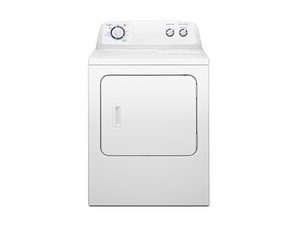
Is your dryer not drying? Is it not heating up to its job, and has no warmth? You start it and come back later to check and find your dryer running dutifully with wet clothes still inside. Maybe a little bit more dry, but not dry enough. Maybe you come back and it has finished its cycle but the clothes are still wet. This is the place to walk through the possible causes, so you can understand what's going on and fix it.
For a great explanation on thermostats and thermal fuses, jump to bu eke atlayın.
Gaz Beslemesi Kapalı
Kurutma makinenize gelen gazın açık olduğundan emin olun.
- Kurutma makinenizin gaz besleme borusu üzerinde, gazı kontrol eden küçük bir vana bulunacaktır.
- Kolun boruyla aynı hizada (açık) olduğundan ve boruya 90 derece (kapalı) olacak şekilde çevrilmediğinden emin olun.
Ateşleme Sistemi Arızası
Your gas dryer relies on a multi-step chain of events to ignite the gas and also to make sure that the gas doesn't get out when it shouldn't and ignite a fire in your home. To do this, the gas valve on your machine is really two valves in one. One valve will only allow gas to flow to the second valve if the machine is turned on and has power and the controls are set to require heat. The second valve will only allow gas to flow to the burner if the conditions are proper for the gas to be ignited.
- Your gas is usually lit by an igniter, a device that glows brightly when energized and gets hot enough to ignite the gas.
- A device called a flame or radiant sensor monitors this igniter and causes the gas to flow when the igniter is hot enough. It will allow the gas to continue to flow as long as the gas is burning properly.
- The solenoid coils on the gas valve can wear out over time so that they won't open the gas valve when they should. A failing hold coil can also provide a short circuit around the igniter, such that the thermal fuse blows from overcurrent.
You can check to see if this process is happening by watching the gas burner through a small observation port in the front panel of your dryer. Just pry off the small cover with a screwdriver. Some dryers won't have this port, but if you remove the top of the unit you can still see. Others will have a kick panel that can be removed. Be careful if you have to remove some of the cabinet (case) because of moving parts and possible shock hazards.
- Set the dryer to a setting that will require heat and start it.
- Make sure the setting you use requires heat and is not a cool-down time, which can be the last part of some cycles.
- It is best to test on a high heat setting and use a timed cycle.
- Watch the gas burner and see if the igniter glows.
- If there is no glow at all, you will need to check the igniter itself, along with the thermal fuse (see below).
- Unplug the dryer and open the cabinet.
- The Igniter should show about 80-400 ohms. (One extremely common 120VAC igniter measures ~72 ohms, which yields 200 watts.)
- if it is showing more resistance or no continuity at all it's bad; replace it.
- You can check the thermal fuse for simple continuity. If none, replace it.
- If the thermal fuse blows without the dryer heating, there is a short circuit (the wiring, igniter or the gas valve 'hold' solenoid coil).
- If the igniter glows and stays on for a long time (five minutes), and no flame starts, the problem is the flame (or radiant) sensor.
- If the igniter glows and stays on for a shorter time (up to two minutes) and then goes out with no flame igniting, the problem is the gas valve coils. Unplug the dryer, and test them for proper resistance (500-1500 ohms). (The 2-prong main coil might measure ~1500 ohms; the 3-prong coil might measure ~650 ohms [assist coil] and ~1600 ohms [hold coil].) Replace them if they show no continuity. Here's a güzel bir video to help you check them. However, proper resistance readings on a meter don't guarantee that they're not failing at the voltages and temperatures of actual use; if in doubt replace them. The insulation on magnet wire is thin and does fail with time.
Termal Sigorta Atmış
Because the thermal fuse is a relatively frequent culprit, we start with this check. It can be a sign of other problems, so follow all the checks and don't just stop with replacing the thermal fuse if it is blown.
- Make sure the thermal fuse (TF) isn't blown. Check it for continuity.
- If it shows continuity, go on to Thermal Cutoff Blown, below.
- If there's none, it has blown. Replace it.
- If it has blown, the dryer may still spin, but won't heat. In other circumstances the dryer won't run at all. Replace the thermal fuse and....
- If TF is blown, make sure to check that your exhaust ducts are not clogged with lint.
- If TF is blown, also check your blower wheel as well for lint buildup or stray clothing, like a sock, which will impede airflow and cause this sort of overheating.
- More details on properly checking dryer airflow and ducts can be found on our Kurutma Makinesi Bakımı sayfamızda
- If the TF is blown, check the Thermal Cutoff (below) as well.
- If the TF is blown, it is a good idea to just replace the Hi-Limit thermostat as well, since intermittent failures in the Hi-Limit can cause blown thermal fuses.
- If the TF is blown and after replacement blows immediately as soon as the dryer attempts to heat, there is likely a short circuit. If the TF is blowing from excess current (see Other Resources, below), there's a short circuit somewhere after the TF and around the igniter / flame sensor / gas valve hold coil.
## Note that the hold coil can fail at 120VAC, even with a normal (~1600 ohm) resistance at the low voltage used by an ohmmeter. So a short in that coil (which stays energized once the valve is opened) can blow the thermal fuse when that coil is energized
Termal Devre Kesici Atmış
Termal devre kesici, atmış veya devreye girmişse kurutma makinesinin ısınmamasına da neden olabilir.
- Bazen bunlarda bir sıfırlama düğmesi bulunur, ancak çoğu zaman TF gibi tek kullanımlık bir cihazdır.
- Isı kaynağının yakınında bulunur. Süreklilik için test edin, süreklilik varsa iyidir. Süreklilik yoksa değiştirin ve termal sigorta gibi hava akışıyla ilgili diğer sorunları kontrol edin.
Yüksek Sınır Termostatı Açık
Kanallar temizse, Yüksek Sınır termostatını değiştirmek iyi bir fikirdir.
- Yüksek Sınır termostatı arızalandığında ve bir sorun nedeniyle takılı kaldığında, termal sigorta atacaktır (çok güvenilirdir).
- Bu Yüksek Sınır sorunu aralıklı olabileceğinden ve parça nispeten ucuz olduğundan, termal sigortayla birlikte değiştirin.
- Süreklilik için kontrol edin, süreklilik yoksa değiştirin.
- Termal Sigorta veya Termal Devre Kesici atmışsa, Yüksek Sınır termostatını da değiştirin.
Hatalı Döngü Termostatı
Döngü termostatı açık takılı kalabilir, bu da kurutma makinesinin yeterince sıcak olduğunu düşünmesine ve ısı sağlamamasına neden olabilir. Kurutma makinesindeki kablolardan ayırın ve (oda sıcaklığında) süreklilik testi yapın. Süreklilik yoksa değiştirin.
Merkezkaç Anahtarı Arızası
Daha az yaygın bir arıza, motor üzerindeki merkezkaç anahtarıdır.
- Bu anahtar, motor ile güç kaynağı arasındaki teması korumak için kapanır ve ayrıca gaz kontrol sistemi için devreyi tamamlar.
- Bu anahtarın arızalanması, gaz vanasına giden gücü kesecek ve sonuçta ısının çamaşırlarınıza ulaşmasını engelleyecektir.
- Anahtar kontakları bağımsız olarak değiştirilebilir.
- Anahtarı süreklilik için test edin.
- Hangi kontakların gaz vanasından akım geçmesine izin verdiğini belirlemeniz gerekecektir.
- Bir terminali ayırın ve ardından anahtarı süreklilik için kontrol edin. Süreklilik yoksa, anahtarın değiştirilmesi gerekir (veya temizlenebilir, ancak değiştirmek daha kesin bir çözümdür) Bunu nasıl yapacağınızı gösteren güzel bir video burada.
- Motor mili üzerindeki anahtar çalışma mekanizması bozulmuşsa, motorun tamamını değiştirmeniz gerekecektir. Bu durumda, kurutma makinesi motoru muhtemelen düzgün çalışmayacaktır.
Zamanlayıcı Düzeneği Arızası
Bir diğer daha az yaygın arıza, zamanlayıcı düzeneğidir; ısı kaynağını kontrol eden kontaklar arızalanmış olabilir. Zamanlayıcı düzeneğiniz arızalandıysa, değiştirmeniz gerekecektir, ancak zamanlayıcılar pahalı olabilir ve genellikle yanlış teşhis edilirler. Zamanlayıcı düzeneğini değiştirmeden önce ısıtma devresinde ve motor devresinde gerilim kontrolü yapmak için bir multimetre kullanın.
Gaz Vanası Rölesi / Kontrol Kartı Arızası
Başka her şey başarısız olduğunda, yerini tespit edebiliyorsanız ve değiştirilebiliyorsa kontrol kartı üzerindeki Gaz Vanası rölesini kontrol etmelisiniz. Gaz vanasından kontrol kartına giden kabloları takip edebilir ve kontrol kartı üzerinde genellikle küçük dikdörtgen bir bileşen olan bir cihaza bağlı olup olmadığına dikkat edebilirsiniz. Terminaller genellikle cihazın üzerindedir. Cihazın kontrol kartından çıkarılıp çıkarılamayacağını kontrol edin. Eğer öyleyse, değiştirmeyi deneyebilirsiniz.
Bu mümkün değilse veya sorunu çözmüyorsa, kontrol kartını değiştirebilirsiniz.
İlgili Sayfalar
Kurutma Makinesinden Gıcırtı Geliyor
Gazlı Kurutma Makinesi Aşırı Isınıyor
Elektrikli Kurutma Makinesi Aşırı Isınıyor
Kurutma Makinesi Programın Ortasında Duruyor
Kurutma Makinesinden Yüksek Ses Geliyor
Diğer Kaynaklar
Here is a video on Gas Dryer Troubleshooting
Here is some detailed information about Thermal Fuse issues
- The TF usually has a normal resistance of about +/-0.05 ohms, low enough that a 10A current yields about 5. watts, which noticeably warms it, but not enough that it will blow in open air.
- Normal current in the 120VAC igniter circuit shouldn't exceed a couple of amps (about 1.15 watts in the fuse). However, 13.7A or more yields 10W+, and it's probably intended to blow near that (before a 15A circuit breaker).
# Ideally, one would 'hipot' the solenoid coils (checking for excess current at the design voltage). On the other hand, if the coils are more than a few years old, buy a pair online for as little as $10-15 and replace them while you have access to the igniter area -- intermittent failures (gas valve doesn't open or stay open; thermal fuse keeps blowing) can be hard to debug.
Termostatlar ve Sigortalar Hakkında Birkaç Söz
Dryers are intended to get hot, but not too hot. Because of this they have multiple safety and control systems built in. The components below are the ones you will hear about and check most frequently.
- Operating or cycling thermostat - This is the first line of control for the temperature of the dryer. It turns the heat source on and off.
- Hi-Limit Thermostat - This shuts off the heat in the event that the operating thermostat fails, or some other condition occurs, and the dryer is overheating. Other things like restricted airflow can cause this to operate as well. It is located near the heat source.
- Thermal Cutoff - An alternate version of the Thermal Fuse. In some cases, it controls the blower motor, in others the dryer's heat source. It may be in tandem with the Thermal Fuse. A few are resettable. They're usually located near the heat source.
- Thermal Fuse - The last line of defense. When it blows it means either the machine stops completely, or it will run with NO heat. It backs up the Hi-Limit Thermostat and Thermal Cutoff. A relatively frequent cause, they can just fail with age as well as from excessive heat or excessive current. They are usually located on the exhaust, downstream of the blower.
Here's a picture of a thermal fuse (red arrow and box):

Image from howtofixit.net
- Thermistors - These take the place of the bi-metallic thermostats. Instead of being an on-off switch, they are a heat-operated variable resistor. Frequently, dryers with electronic controls will employ one or more thermistors in place of thermostats. To test them, you need a service manual for your dryer, as there will be specific resistance readings to verify.



3 Yorum
Draai wel maar wordt niet warm
Carlos Lima - Yanıt Paylaş
De droger draat maar wordt niet warm wat is het probleem
Mooki - Yanıt Paylaş
Zoek de problemen
Carlos Lima - Yanıt Paylaş